
The science
Why eczema-prone skin needs its bacteria back.
Eczema-prone skin isn't just dry. Research shows it's missing many of the helpful bacteria healthy skin carries, while one troublemaker, Staphylococcus aureus, takes over. That's the gap live cultures are built to fill.
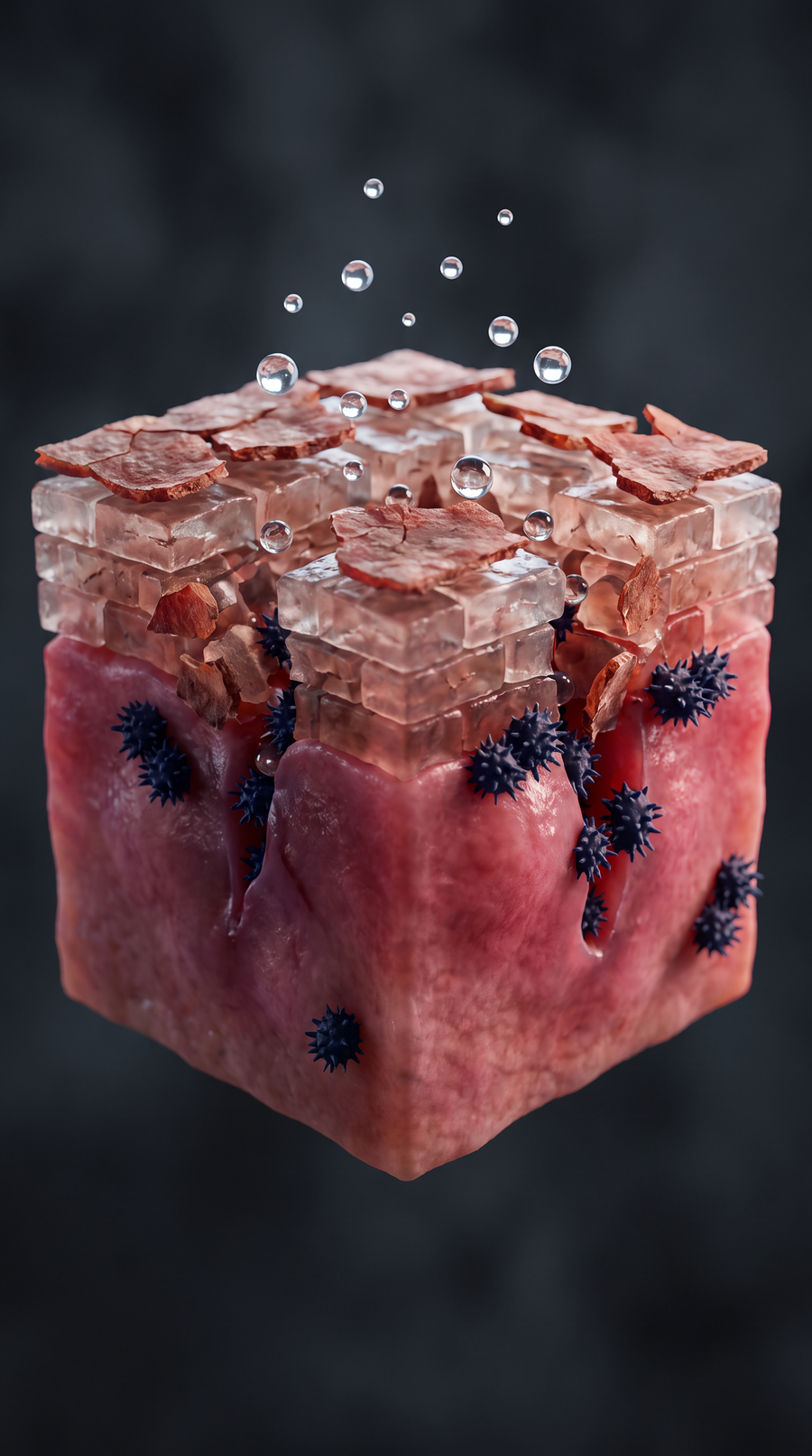

Illustrations, not lab data.
The problem
A loop that keeps itself going.
- 1
The barrier leaks
Moisture escapes and irritants get in.
- 2
S. aureus takes over
With fewer helpful bacteria to compete, Staphylococcus aureus crowds the surface and releases toxins that weaken the barrier further.
- 3
The immune system overreacts
Redness and itch follow, and that inflammation weakens the barrier again. Treat one part and the other two pull it back.
How Active Restore Cream helps
Three jobs. One cream.
- 1
Crowd out the troublemaker
Live lactobacilli compete with S. aureus for space and resources on your skin.
- 2
Calm the overreaction
Helpful bacteria and the postbiotic ProBio65® help skin settle, so it looks and feels calmer.
- 3
Rebuild the barrier
Live cultures, an inulin prebiotic and the Essence Oil Blend support the moisture barrier eczema-prone skin struggles to hold.
Research: NIH researchers applied a healthy-skin bacterium to people with eczema and saw less itch and better barrier function (NIH, 2020). UC San Diego showed eczema skin lacks bacteria that fight S. aureus, and restoring them helped in a randomized trial (UC San Diego). A postbiotic cream reduced eczema severity and itch in a 75-person placebo-controlled trial (British Journal of Dermatology, 2008). Studies on the researchers' own formulas, not on Active Restore Cream. Cosmetic product, not intended to diagnose, treat, cure or prevent any disease.
What the research says
15 years of research, one direction.
Researchers keep finding that eczema-prone skin has lost its helpful bacteria, and that putting live ones back helps. Studies on the researchers' own formulas, not on Active Restore Cream.
2008: A postbiotic cream cut itch
In a 75-person placebo-controlled trial, a cream with a bacterial postbiotic significantly reduced eczema severity and itch in 30 days.
Gueniche et al., British Journal of Dermatology
2012: Flares follow the bacteria
NIH researchers tracked children's skin bacteria over time. During flares, S. aureus took over and diversity dropped.
Kong et al., Genome Research
Read the study2017: Eczema skin is missing its defenders
Healthy skin carries bacteria that make natural antimicrobials against S. aureus. Eczema skin is short on them, and putting them back reduced S. aureus.
Nakatsuji et al., Science Translational Medicine
Read more2018: Live bacteria, applied to skin, helped
6 of 10 adults and 4 of 5 children improved by more than half after a live healthy-skin bacterium was applied. Many needed fewer steroid creams.
Myles et al., JCI Insight (NIH)
Read more2020: A live Lactobacillus ointment for eczema
36 adults used live L. reuteri ointment or a plain one for 8 weeks. The live version significantly improved eczema scores. L. reuteri is one of the three species in our cream.
Butler et al., Microorganisms
Read the study2021: Placebo-controlled, 54 adults
A healthy-skin bacterium applied for one week was safe and reduced S. aureus. People whose S. aureus it could kill saw their eczema scores improve.
Nakatsuji et al., Nature Medicine
Read the studyLactobacilli support the barrier
They can compete with unwanted microbes and help support skin barrier function.
Delanghe et al., Biochem Soc Trans, 2021
Read the reviewApplied to skin, they take hold
Topically applied lactobacilli temporarily colonized skin in clinical trials. Hence morning and night.
Delanghe et al., 2021
Read the reviewWhat's in the cream
3 biotics. 1 cream.
Pre, pro and postbiotic, mixed fresh by you.
Probiotic
3 live Lactobacillus strains, activated fresh.
Prebiotic
Inulin from chicory root. Food for good microbes.
Postbiotic
ProBio65™ helps skin look and feel calmer.
Third-party verified
Cultures tested live and active.
Questions
No. Active Restore Cream is a cosmetic, not a medicine. It's built to support your skin's barrier and microbiome, which is what eczema-prone skin struggles with. If you have a diagnosed condition, keep working with your dermatologist.
A moisturizer can seal the surface for a few hours. Eczema-prone skin is also short on the helpful bacteria that keep S. aureus in check. Live cultures go after that part of the loop.
Many people use a daily moisturizer alongside prescription treatments. Check with your dermatologist about how to fit it into your routine.
Talk to your pediatrician before using it on children.